
CORE INSIGHT™
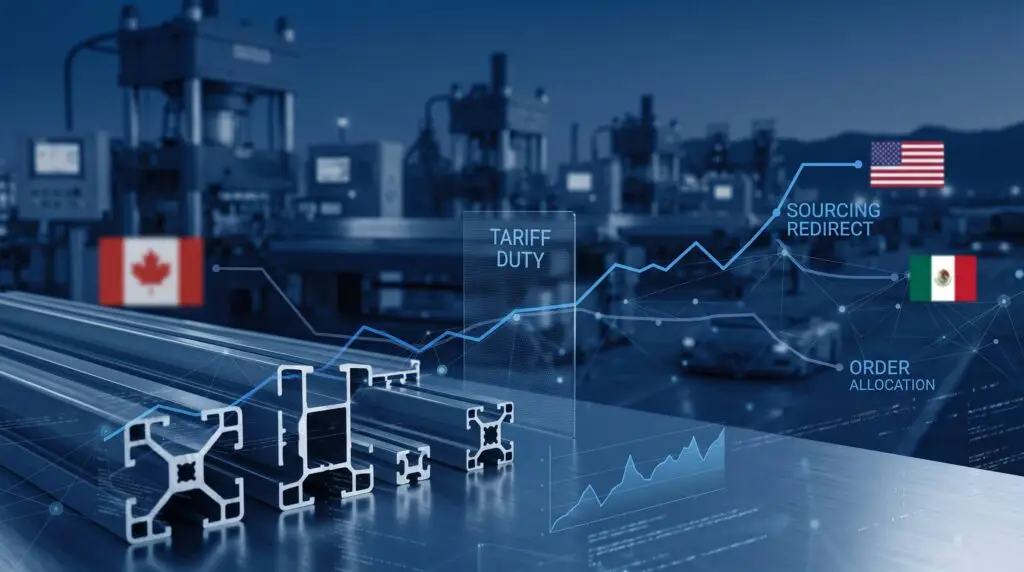
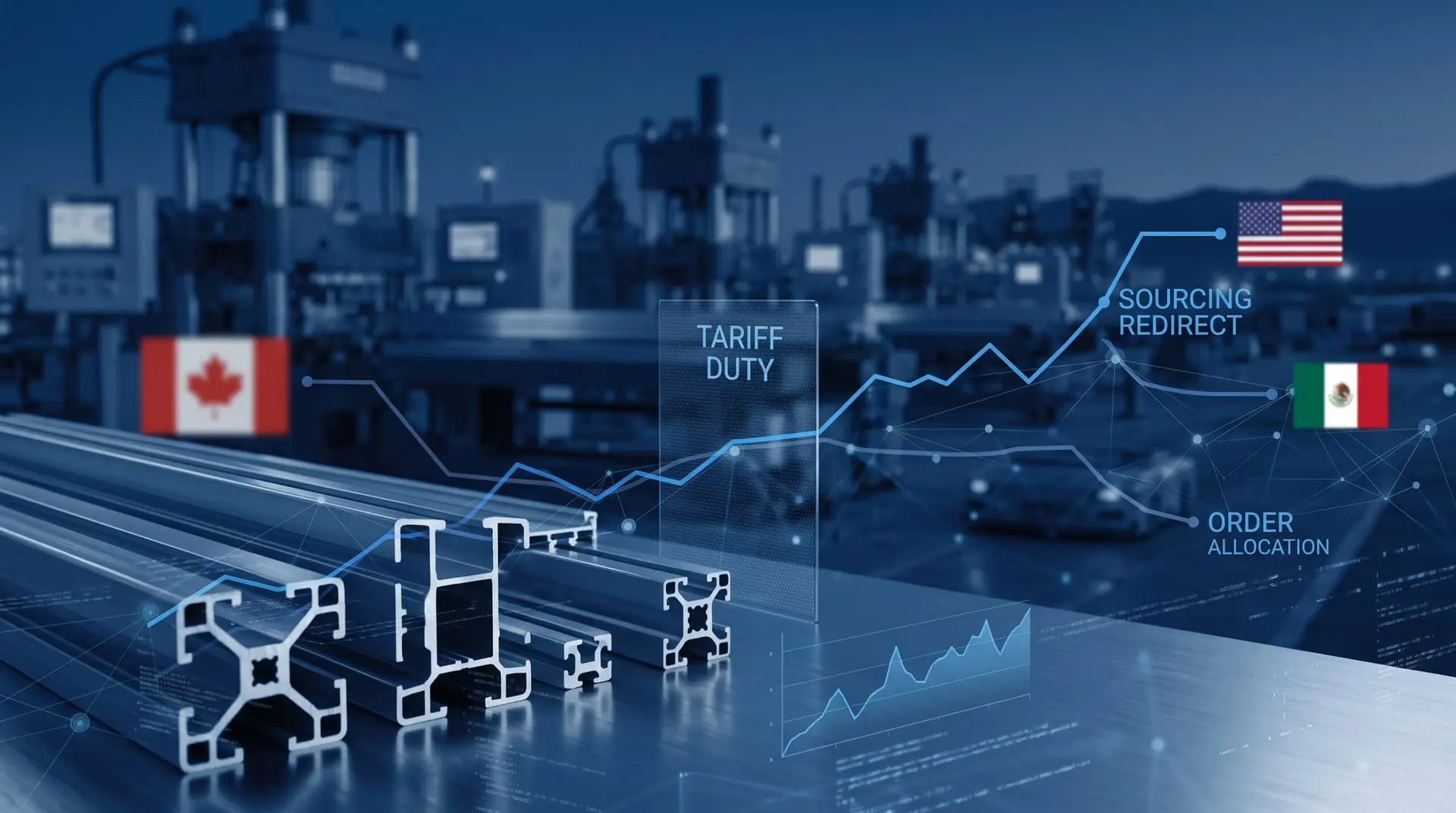
Steel and aluminum tariffs change trade flows in two stages. Purchase orders move first: when a duty abruptly raises the delivered cost of an established supplier, buyers begin testing alternative sources within weeks. Production moves second, if at all: presses, plants and billet supply chains take years to relocate. The US tariff on Canadian aluminum extrusions is a clear example — its first effects appear in inquiries, order allocation and lead times across the US, Canada and Mexico, not in new capacity.
Why do steel aluminum tariffs move orders before they move plants?
Extrusion plants, presses and billet supply chains cannot be relocated overnight. Purchase orders can. When a tariff materially changes the delivered cost of a long-standing supplier, buyers do not wait for the industry to restructure. They start asking other suppliers for quotes.
That is why the first visible effect of a new duty is commercial, not industrial:
- Inquiries rise at suppliers outside the tariffed route
- Order allocation shifts among domestic, tariffed and non-tariffed sources
- Lead times lengthen at suppliers absorbing new demand
- Billet purchasing changes as extruders anticipate different operating rates
Capacity may follow years later, or never. The sourcing pattern can change within a quarter.
Key takeaway: Market access changes faster than capacity. Steel aluminum tariffs are felt in purchasing behavior long before they are felt in production.
What happened to the US–Canada extrusion trade route?
Canada has long been one of the largest suppliers of aluminum extrusions to the United States, on top of existing Section 232 duties on steel and aluminum. A steep additional US tariff on covered Canadian extrusions — layered on top of those Section 232 duties — created a significant new barrier along that route.
The rate is the headline. The market question is different: how quickly do US buyers revisit the way they divide purchases among domestic, Canadian and Mexican extruders when the cost of one route changes abruptly?
Not every order moves. Sourcing decisions still depend on:
- Product qualifications — alloy, die and tolerance approvals take time to replicate
- Customer relationships — established suppliers hold service and reliability advantages
- Available press capacity — alternative suppliers may not have open slots
- Lead times and freight — a cheaper source is not useful if it cannot deliver on schedule
A tariff shifts the balance of those factors. It does not erase them.
How does a tariff on one route affect the whole North American market?
A duty aimed at one trade lane changes decisions across the regional value chain. Each participant reassesses its position:
| Participant | Question the tariff raises | First observable response |
|---|---|---|
| US extrusion buyers | Which suppliers can replace tariffed volume at acceptable cost? | New inquiries, split allocations, trial orders |
| US extruders | Can we absorb additional demand at current capacity? | Longer lead times, selective order acceptance |
| Canadian extruders | Where else can displaced volume go? | Offers into other export markets, price adjustments |
| Mexican extruders | Is this a durable opportunity or a temporary spike? | Stronger interest from US buyers, capacity checks |
| Billet and primary suppliers | Whose operating rates are changing, and where? | Shifts in billet inquiries by region |
The effect extends well beyond the border. When US extruders run harder, their billet requirements rise; when Canadian extruders lose orders, theirs fall. Upstream suppliers see the tariff as a change in who needs metal, and where.
Is a tariff-driven sourcing shift permanent?
Not necessarily. The market distinguishes between two outcomes:
- Temporary repositioning — buyers test alternatives, secure some volume, and revert partially if the tariff is modified, exempted, or absorbed through pricing.
- Lasting shift — buyers requalify products at new suppliers, sign longer agreements, and alternative extruders invest in capacity to hold the business.
Which one materializes depends on how long the tariff stays, how much of the cost is absorbed along the chain, and whether alternative suppliers can actually deliver at scale. Steel aluminum tariffs that survive several quarters and cover most relevant products tend to produce lasting shifts; those subject to exemptions, quotas or legal challenge tend to produce repositioning.
Key takeaway: The rate of a tariff determines its shock. Its durability and coverage determine whether sourcing patterns actually change.
What should the market watch?
The clearest early signals come from commercial activity, in this order:
- US extruders — are inquiries and order books growing, and are lead times extending?
- Mexican suppliers — are US buyers placing trial or repeat orders?
- Canadian producers — are they seeking alternative destinations or adjusting offers?
- Order coverage — are buyers contracting further ahead to lock in non-tariffed supply?
- Billet purchasing — are regional billet requirements shifting in line with extrusion order flows?
Changes in lead times, order coverage and billet purchasing show whether the tariff is producing a lasting shift or a temporary period of repositioning.
Who does this matter for?
- Extrusion buyers and procurement teams deciding whether to requalify suppliers or wait
- Extruders in the US, Canada and Mexico reading demand signals and capacity needs
- Billet and primary aluminum suppliers whose regional demand follows extrusion operating rates
- Traders and analysts assessing whether a trade measure changes structural flows
How HARBOR tracks tariff effects on the extrusion market
HARBOR monitors North American extrusion and billet flows, tracking order activity, regional demand shifts and the billet implications of changing operating rates. That volume intelligence, together with HARBOR’s outlook for how the tariff reshapes regional sourcing, is part of its subscriber service and is not published here.
Frequently asked questions
What are steel aluminum tariffs?
Steel and aluminum tariffs are import duties the United States applies to steel and aluminum products entering the country. The best known are Section 232 tariffs, imposed on national-security grounds. Additional measures can be layered on top for specific products or countries, such as duties on aluminum extrusions.
How do US aluminum tariffs affect Canada?
Canada is a major supplier of primary aluminum and extrusions to the US. Tariffs raise the delivered cost of Canadian metal, prompting US buyers to reconsider allocation among Canadian, domestic and Mexican sources, and pushing Canadian producers to seek alternative markets.
Why do purchase orders move faster than production after a tariff?
Because placing an order with a different supplier takes days, while building or relocating a press line takes years. Buyers respond to a cost change immediately; the industrial base responds only if the change persists.
Does a tariff mean all imports from the affected country stop?
No. Product qualifications, relationships, capacity limits at alternative suppliers and freight logistics keep some volume flowing. A tariff shifts the share of purchases, not all of them.
What is the difference between Section 232 and other tariffs?
Section 232 tariffs are broad duties on steel and aluminum justified on national-security grounds. Other tariff authorities allow targeted duties on specific products or countries, and can be stacked on top of Section 232, raising the all-in rate on covered goods.
How do extrusion tariffs affect billet demand?
Extruders buy billet to run their presses. When tariffs shift orders from one country’s extruders to another’s, billet demand moves with them: rising where operating rates increase and falling where they decline.
How can you tell if a tariff-driven sourcing shift will last?
Watch whether buyers requalify products at new suppliers, sign longer agreements, and whether alternative extruders add capacity. Those steps signal a lasting shift; trial orders that revert signal temporary repositioning.
The question behind the rate
Steel aluminum tariffs are usually reported as a number. The number determines the shock. What determines the outcome is whether the measure changes where North American extrusion demand is placed — and how long the new pattern lasts. The answer shows up first in order books, lead times and billet purchasing, not in production statistics.
HARBOR tracks those order flows and their billet implications across the US, Canada and Mexico, and maintains an outlook on how the tariff reshapes regional sourcing.